
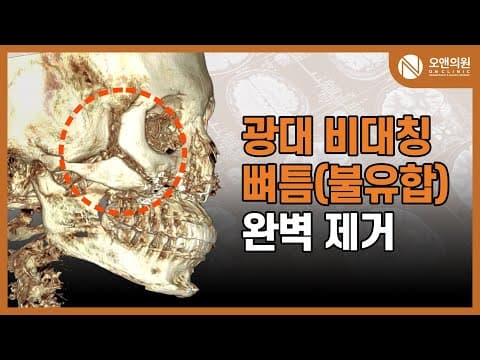
Complex Cheekbone Revision Surgery: Achieving Perfect Improvement Beyond Bone Gaps and Asymmetry
Before visiting On Clinic, the patient had already undergone two cheekbone surgeries, orthognathic surgery, and V-line surgery. Through these multiple facial contouring procedures, numerous fixation pins remained in the face, and the patient's primary concerns were asymmetry in the cheekbone area and severe bone gaps (non-union).
Cheekbone Revision Surgery: What Were the Issues?
I, Dr. Myungjun Oh, meticulously analyzed the patient's current condition through CT scan results.
"They had two cheekbone surgeries, orthognathic surgery, and even V-line surgery. So, there are so, so many pins in their face."
Indeed, a total of 20 fixation pins from the orthognathic and cheekbone surgeries were embedded in the patient's face. While some pins did not significantly impede the cheekbone revision surgery and did not require removal, certain pins absolutely needed to be removed.
A more serious problem was the asymmetry and bone gaps in the cheekbones.
- Right Cheekbone: It was excessively long, measuring 27mm, and had a bone gap width of a staggering 8mm, indicating an unstable state where the bone was barely attached.
- Left Cheekbone: It was relatively shorter.
"If you look at the right side, this area is a bone gap, but it's hard to see like this. Well, you can see there's a large bone gap like this. This length is 27mm, and the vertical width is 8mm."
These bone gaps were barely held together by fixation pins, posing a risk of the bone detaching immediately if the pins were removed. This was a critical situation, threatening not only aesthetic issues but also functional stability.
On Clinic's Precise Surgical Plan and Successful Outcome
Considering the patient's complex situation, Dr. Myungjun Oh established the following surgical goals:
"The surgical goals are to remove the 20 unnecessary pins, improve cheekbone asymmetry, and eliminate the bone gaps."
The surgery focused not merely on reducing or repositioning the bone, but on achieving stable bone fusion and overall facial harmony. Specifically, the key challenge was to perfectly fill the 8mm wide bone gap and ensure the bone fused firmly.
One week after surgery, the patient revisited On Clinic for a follow-up. Comparing the CT images, it was confirmed that the severe bone gap in the right cheekbone, present before surgery, had been perfectly improved, and the bone had firmly fused.
"The bone gap was 8mm, and the length was 27mm, but it's completely gone. Completely. If it fuses this well, you won't even see a line after a year."
Cheekbone asymmetry was also significantly improved. While subtle asymmetry might remain due to other factors that cannot be resolved surgically, such as eye asymmetry or skull asymmetry, the cheekbone asymmetry itself was successfully addressed. The patient expressed great satisfaction, looking in the mirror at their noticeably smaller and younger-looking face.
"There's a difference. It's perfect." "You look younger."
On Clinic strives to accurately diagnose each patient's condition in such complex revision surgery cases and achieve optimal results through precise surgical planning and skilled techniques.
Dr. Myungjun Oh, On Clinic | Last Reviewed 2024-05-23