
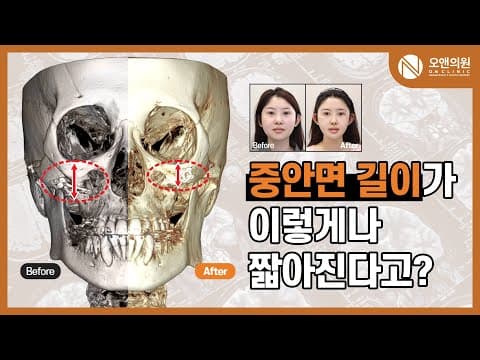
This patient had previously undergone cheekbone surgery but visited On Clinic due to unsatisfactory results. Specifically, the left cheekbone was excessively long, and there was a 'non-union' condition where the bone had not properly fused after the previous surgery. The severe asymmetry between both cheekbones also contributed to the appearance of an elongated midface.
On Clinic's Precise Diagnosis and Customized Revision Surgery Plan
At On Clinic, we conducted a detailed CT scan to accurately assess the patient's condition. CT analysis revealed that in the previous surgery, the left cheekbone had been osteotomized (cut) in the middle, rather than at the normal position, resulting in an elongated bone and a confirmed non-union where the bone had not fully fused. The osteotomy position on the opposite cheekbone was also inappropriate, further accentuating the asymmetry between the two sides.
I thoroughly explained the current situation to the patient and proposed a customized plan for revision surgery to improve the asymmetry and effectively reduce the midface length. Specifically, if the non-union site showed any instability during surgery, the pins would be removed, and the bone would be reconnected precisely and securely fixed. If the site was stable, the existing pins would be utilized to connect it in the same manner as the opposite side, aiming for symmetry.
"The problem is that the left cheekbone is too long. But on the opposite side, the bone was cut in the middle. It should have been cut here, but it was cut here, in the middle. The bone didn't fuse. It's a non-union. The hospital that performed the previous surgery did a really strange job. If the pins are loose, I will reconnect them during surgery. If they are firm, I will connect them exactly like the opposite side. We also corrected the asymmetry."
Post-Surgery Changes and Patient Satisfaction
Post-surgery CT images clearly showed significant improvement. The elongated midface length was reduced by nearly half, and the asymmetry from the previous surgery was greatly improved. Upon seeing the CT images, the patient expressed surprise and satisfaction, exclaiming, "Oh my god! This is amazing!" It was particularly evident that the cheekbone asymmetry, which was more pronounced when viewed from below, had been effectively corrected.
Recovery Process and the Importance of Consistent Care
Even one week after surgery, the patient was dedicated to recovery. I guided the patient through important exercises to aid recovery: four movements including opening the mouth wide, pushing the jaw forward, and moving it left and right. Practicing these consistently twice a day is crucial for smooth temporomandibular joint movement and stable recovery of the surgical site.
When is Cheekbone Revision Surgery Necessary at On Clinic?
Cheekbone revision surgery is a complex procedure that requires consideration of not only aesthetic improvements but also functional aspects. You might consider cheekbone revision surgery in the following cases:
- Non-union or Malunion: When the bone has not properly fused or has fused abnormally after a previous surgery.
- Severe Asymmetry: When there is still significant left-right facial asymmetry even after surgery.
- Over-reduction or Under-reduction: When the cheekbones have been reduced excessively or insufficiently compared to expectations.
- Midface Length Issues: When a side effect of elongated midface appears after cheekbone surgery.
- Functional Problems: When functional discomfort such as temporomandibular joint pain or difficulty opening the mouth is present.
On Clinic strives to accurately diagnose these complex issues and provide optimized revision surgery solutions tailored to each patient.
Dr. Myungjun Oh, On Clinic | Last Reviewed 2026-05-23