
Why Choose On Clinic for V-Line Surgery
Hello, I'm Dr. Myung-jun Oh from On Clinic. Today, I'd like to share the story of a patient who underwent V-line jaw surgery after a cheekbone revision surgery. Approximately one month prior, the patient had received cheekbone revision surgery from me and was so satisfied with the results that they decided to proceed with V-line surgery. During the initial consultation, the patient still had some swelling from the cheekbone surgery but was already noticing changes in their facial contour.
The patient wished to improve their blunt-looking chin. Rather than simply shaving the jawbone, I designed the procedure considering the overall harmony and natural lines of the face. Specifically, I focused on preserving the jaw angle as much as possible while creating a shorter, rounder appearance, aiming for a smaller and softer overall facial look that complemented the previously reduced midface.
The Importance of Cortical Bone Excision and Asymmetry Correction
One of the most common questions people have about V-line surgery concerns cortical bone excision. The patient also asked, 'Do I need to have the cortical bone removed?' I explained that both the outer and inner cortical layers should be excised simultaneously. If only the outer cortical layer is removed, the jawline can actually sag and droop. Therefore, a precise understanding of bone structure and a delicate approach are essential for enhancing post-surgical satisfaction and stability.
Furthermore, the patient was concerned about jaw asymmetry. While CT scans confirmed a slight deviation in the lower jaw, it's challenging to achieve perfect symmetry through surgery for pre-existing asymmetry. Instead, I focused on making the right jaw slightly shorter while preserving its angle, and adjusted the height difference between both sides to create the most balanced line possible.
"Cortical bone must be excised by simultaneously cutting both the outer and inner cortical layers. If only the outer layer is removed, the jawline can actually sag and droop." – Dr. Myung-jun Oh
Post-Surgical Pain and Recovery Process
When asked which was more painful between the cheekbone surgery and the jaw surgery, the patient surprisingly stated that the jaw surgery was not painful at all. They also mentioned that the swelling was not severe, which likely benefited from the long-term use of a compression band. The swelling in the lower jaw will continue to subside over time, resulting in an even more slender line.
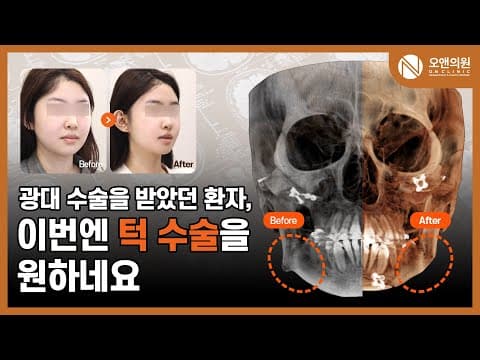
Pre-operative CT scans showed that the patient had a slightly protruding mouth and a tendency for a long chin. Post-surgery, the mouth appeared to recede, and the jawline improved, creating such a dramatic change that the patient might even be asked if they had undergone orthognathic surgery. The nerve line, which was the patient's biggest concern, was also perfectly avoided, ensuring a safe procedure.
- Pre-surgery: Protruding mouth and long chin appearance
- Post-surgery: Receded mouth and shortened jawline, transforming into a refined impression
Long-term Management and Patient Satisfaction
Comparing with pre-surgery photos, the patient was very satisfied to see that the jaw length had clearly shortened and the face appeared smaller, even with some residual swelling. In particular, they noted that the improvement in the square jaw was much better than expected. It's crucial to maintain an appropriate jaw angle while refining the line, as excessively rounding the angle can lead to skin sagging. In this patient's case, by adhering to these principles, we were able to achieve a beautiful line without sagging. I informed the patient of our plan to monitor their progress at 2, 6, and 10-month intervals and to further improve skin contraction through lifting procedures such as Ulthera and Thermage at the dermatology clinic. This will help maintain a more elastic and beautiful facial contour in the long term. The patient expressed gratitude for the highly satisfactory results and promised to return for their next follow-up.
Chat with us now for a consultation
Dr. Myung-jun Oh, On Clinic | Last reviewed 2024-05-23