
Malar Midface Reduction Surgery: Transforming a Broad Face into a Smaller, More Defined One
Many people are concerned about having a broad-looking face or a large head shape. Particularly, if the cheekbone area (malar region) is prominent, the face can appear even wider. At On Clinic, we address these concerns with 'Malar Midface Reduction Surgery' to improve overall facial proportions and create a smaller, more contoured facial line. Beyond simply reducing bone, a delicate approach that finds the golden ratio of the face is crucial.
Analyzing the Cause of a Broad Face and Large-Looking Head Shape
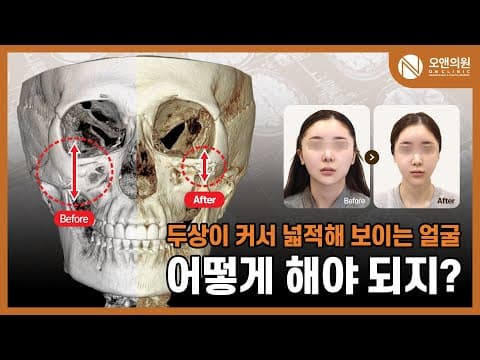
During the consultation, the patient expressed concerns about a broad face and a noticeably large-looking head shape. Specifically, the right malar region was more developed, contributing to an asymmetrical impression. Dr. Myungjun Oh thoroughly analyzed the patient's skeletal structure through visual examination and 3D CT scans.
"Your head shape appears large, especially on the right side. We will try to make it look as small as possible. Of course, the actual size of your head won't shrink. However, after the surgery, your head will visually appear smaller because currently, your cheekbones are wider than your head." — Dr. Myungjun Oh
Dr. Oh explained that rather than the actual size of the patient's head, the cheekbones protruding wider than the head created a visual illusion of a larger face. Based on this analysis, the focus was on effectively reducing the cheekbones and adjusting the midface length to achieve overall facial balance.
On Clinic's Unique 'Malar Midface Reduction' Surgical Principle
On Clinic's Malar Midface Reduction Surgery is a comprehensive approach that goes beyond simply shaving the cheekbones; it reduces the length and narrows the width of the midface, the central part of the face. The key is to precisely adjust the position of the cheekbones to reduce facial width and enhance three-dimensionality by preserving the volume of the anterior cheekbones.
- Precise Osteotomy: Specific prominent areas of the cheekbones are precisely osteotomized (cut).
- Inward and Upward Repositioning: The osteotomized bone is pushed inward to reduce facial width and simultaneously moved upward to visually shorten the midface length.
- Secure Fixation: The repositioned bone is securely fixed using special plates and screws to prevent recurrence and maintain natural results.
"We will remove the bone in the marked area and lift the lower bone upwards." — Dr. Myungjun Oh
Through this process, not only the horizontal width but also the vertical length of the face is improved, creating an overall smaller and more harmonious face.
Post-Surgery Changes: Visual Improvement and Impression Transformation
After the surgery, the patient's face showed remarkable changes. The broad midface, which was apparent before surgery, significantly reduced, and the facial width narrowed, transforming into an overall slimmer and softer impression. In particular, the patient expressed satisfaction, noting that their eyes appeared larger and their chin seemed shorter.
- Reduced facial width and creation of a slimmer line
- Enhanced youthful appearance due to shortened midface length
- Relative enlargement and clearer definition of eyes and facial features
- Overall transformation into a softer and more refined impression
"Your eyes appear larger, don't they? This is because the improved proportions make them visually appear bigger." — Dr. Myungjun Oh
This is not merely the effect of swelling reduction but a visual effect resulting from an ideal improvement in facial proportions. As the midface shortens and the cheekbones find their proper position, the facial features become more prominent.
On Clinic's Approach for Safe Surgery Without Cheek Sagging
Many people worry about cheek sagging after cheekbone surgery. At On Clinic, we make the following efforts to minimize such sagging and ensure safe results.
- Simultaneous Ligament Lift: When repositioning the cheekbones, we lift the retaining ligaments that support the skin and tissues, actively preventing potential sagging after surgery.
- Systematic Post-Operative Care: Approximately 3 months after surgery, we monitor the progress. If necessary, we recommend high-frequency/ultrasound lifting procedures like Ulthera or Thermage to enhance skin elasticity and promote tightening, completing a more taut and smooth facial line.
"There is no cheek sagging because we lift the retaining ligaments along with the bone. However, the skin needs to be tightened. So, when we review your progress about 3 months later, I will recommend skin tightening procedures like Ulthera or Thermage." — Dr. Myungjun Oh
Remarkable Changes Confirmed with 3D CT: Before & After
Before-and-after comparisons using 3D CT scans clearly demonstrate the dramatic changes from the surgery. It can be confirmed that the previously protruding cheekbones have moved deeply inward, significantly reducing facial width and shortening the midface length. Particularly impressive in the CT images viewed from bottom to top is how the cheekbones have moved inward, showing that 'the space has completely disappeared'.
"You can see the midface length has shortened, right? The bone that was here has moved all the way inward. The space has completely disappeared, hasn't it? Yes, that's right. The space is gone. People with a large head shape absolutely need to reduce that space. So, you can see that the face has become smaller than the head shape around the temples, right? Will your face become much smaller than it is now? Much smaller. Much!" — Dr. Myungjun Oh
This change in bone structure leads to remarkable results that go beyond mere numerical reduction, improving the overall facial proportions and impression. As time passes after surgery, swelling fully subsides, and the skin adheres more closely to the bone, the face will become much smaller than its current state, completing a natural beauty. On Clinic continuously researches and strives to provide the most harmonious changes for each patient's face.
On Clinic Dr. Myungjun Oh | Last reviewed 2026-05-23