
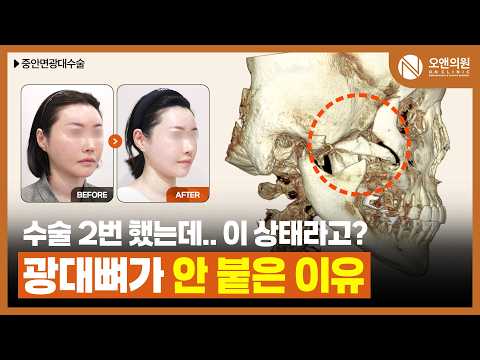
I recently met a patient in my consultation room who, despite having undergone two previous zygoma surgeries, was still experiencing stress regarding their facial proportions. The patient felt their face looked larger whenever they wore a hat, and this concern extended beyond aesthetics, impacting their daily life.
Problems with Previous Zygoma Surgery: Diagnosis of 'Non-Union'
The moment I reviewed the patient's CT scan, I was shocked. The zygoma bone was completely separated, like a piece of chalk. A clear black line was visible between the bones, indicating that they had not fused at all. Typically, non-union refers to cases where bones are partially unfused, but in this patient, the bones were completely separated, making the term 'non-union' almost an understatement. Even the posterior part of the zygoma was unfused.
Surprisingly, the patient did not experience any bone movement or functional discomfort. However, aesthetically, there was a step-off deformity on their face, which was a significant source of stress for the patient. It was determined that the bones were either not properly fixed in the previous surgery, or they failed to fuse even if fixed. Furthermore, the midface length differed significantly on both sides (24mm and 20mm), indicating severe facial asymmetry.
On Clinic's Revision Surgery Goal: Perfect Fusion and Proportion Improvement
I promised the patient that I would achieve over 90% fusion of these completely separated bones. My surgery prioritizes ensuring definite bone fusion. Post-operative CT scans confirmed that the zygoma was perfectly fused. As the bones completely fused, the black line visible before surgery disappeared, and the area improved so naturally that no line was discernible.
The zygoma, which was previously next to the nose, was now repositioned next to the eyes, shortening the midface length to 10mm on both sides, and making the overall facial proportions much more harmonious. The patient mentioned that their mouth corners seemed slightly lifted after surgery, suggesting a positive change in facial muscle tension due to the improved bone position.
Misconceptions About Post-Operative Care and Lifting
After surgery, it's crucial for the skin to adhere closely to the bone as swelling subsides. I explained to the patient that we would begin personalized 1:1 lifting management for skin tightening starting from the one-month mark. At this point, many patients consider a facelift, but after zygoma surgery, a facelift may be unnecessary or even detrimental.
A facelift involves pulling up the skin near the ears, but the skin around the cheekbones is pulled less, which can make skin sagging appear worse than before the surgery. Furthermore, due to residual swelling, sagging may not be noticeable for 1-2 years post-surgery. However, once the swelling completely subsides, the skin may appear more lax, often leading to the misconception of needing another facelift. Therefore, after zygoma surgery, customized lifting management that promotes skin adhesion to the bone and collagen production is essential.
Through this zygoma revision surgery, the patient achieved satisfactory results, including perfect bone fusion and improved facial proportions. I am also very pleased to have helped the patient regain natural beauty and confidence in their face.
Dr. Myungjun Oh, On Clinic | Last Reviewed 2026-05-23