

During Titanium Lift consultations, I am often asked, "There are so many dermatology clinics around Seolleung — isn't it pretty much the same wherever I go?" Judging by location and price alone, it can feel that way. But what truly divides the outcome in the exam room is the diagnosis on which the same device is used. Even when the concern is the same loss of firmness, the underlying cause differs from person to person.
In this article, I first explain what kind of procedure the Titanium Lift is, and then lay out, from an exam-room perspective, two criteria worth checking when choosing a dermatology clinic.
Titanium Lift: how far does the device's part go?
The Titanium Lift is a laser-based lifting procedure focused on improving skin firmness. Compared with other lifting procedures, it is known for relatively little pain and a short downtime, or recovery period, so the burden of returning to daily life tends to be lighter. It is often performed without separate anesthesia, and some people feel their skin texture looks more refined right after the procedure.
This much comes down to the characteristics of the device. However, how much you feel it and how long the effect lasts can vary with your individual skin condition. Even for a comfortable procedure with short downtime, what ultimately decides the outcome is the diagnosis and planning done before the procedure.
How accurately the skin condition is assessed, and how the intensity and method are designed to match it. In the exam room, we consider this process to be half of the Titanium Lift.
Even with the same device, the way the procedure is designed can differ depending on the medical team's diagnostic approach and experience. So when choosing a dermatology clinic, I recommend looking not only at the name of the device but also at the judgment on which that device is handled.
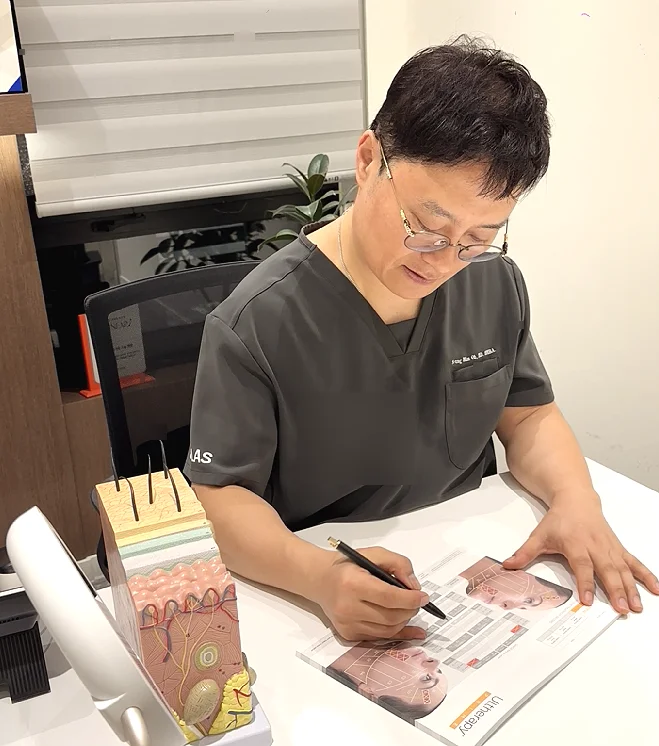
The first criterion: does the clinic ask back about the cause of the firmness loss?
Loss of firmness may look similar on the surface, but its background differs from person to person. Even listing only the causes we commonly encounter in the exam room, they break down as follows.
- Collagen damage from excessive UV exposure
- Firmness loss that appears as the skin barrier weakens
- Changes in skin thickness with aging
The approach of "your firmness has dropped, so just get a lifting procedure" is not wrong in itself. But if the cause is not identified first, the intensity and direction of the procedure can end up out of step with the skin's condition. The experience of not being satisfied even after getting lifting procedures at several places is, in more than a few cases, related to this point.
At On Clinic, we ask a few things in return of those who visit for firmness loss: since when the loss of firmness has been felt, what the sun-protection habits are like, how dry the skin is and what the barrier condition is, and whether there is any prior procedure history. Through this process, we design together an intensity that puts less strain on the skin and a direction in which the effect can last longer.
In particular, when high-output procedures have been repeated on a skin barrier that is already much weakened, it can be hard to get the desired result. In such cases, it often helps to first check the skin thickness and barrier condition, proceed at an appropriate intensity, and provide guidance on moisturizing and regeneration care alongside. The reason the starting point diverges depending on whether firmness or sagging comes first is covered in a little more detail in the exam-room criteria that separate lifting choices.
In short, when choosing a dermatology clinic, I recommend checking for yourself during the consultation whether the medical team asks enough questions, communicates, and examines the skin condition carefully.


The background to why the duration of a lifting effect varies between individuals can be found next in why we look at depth before shot count.
Get a consultation via chat now
The second criterion: the medical team's experience in handling the device
The result of a Titanium Lift can depend as much on the medical team's experience and judgment as on the device's performance. The intensity and approach change according to skin thickness, degree of sagging, and the cause of firmness loss, and this judgment comes not from the device but from clinical experience.
Even for the same Titanium Lift, dividing what is the device's part from what is the medical team's part sorts out as follows.
| Category | What the device determines | What the medical team designs |
|---|---|---|
| Procedure method | Heat-transfer principle, delivery method | What output and depth to approach with |
| Intensity control | Range of output | An appropriate intensity for the skin condition |
| In-procedure judgment | Consistent delivery performance | The decision to adjust intensity while watching the response |
| Aftercare | Not applicable | Guidance on moisturizing and regeneration care |
What output and method to approach with, and how to adjust during the procedure according to the skin's response, allow for a more personalized approach when the know-how built up from experiencing a wide range of skin types is reflected.
At On Clinic, we measure and analyze the skin condition with the AI skin analyzer MUSE, and based on those results we design the procedure each time with an intensity and method suited to the individual. It is an approach that draws on objective data together with the medical team's experience. How much aftercare determines the result is also addressed in can regeneration cream alone keep the effect lasting.
When choosing a dermatology clinic, rather than comparing only the type of device or the price, checking for yourself in the consultation how the medical team examines and plans helps you find a direction suited to your own skin. The overall criteria for choosing a dermatology clinic are laid out separately in criteria for choosing a Sinnonhyeon dermatology clinic, told directly by the medical team.


What to know before the procedure, and how to care for the skin afterward
The effect and response of a Titanium Lift can vary with individual skin condition. The treated area may show temporary redness, swelling, a warm sensation, pain, and the like, and the degree differs from person to person.
Laying out the flow before and after the procedure in order, it goes as follows.
- Share your skin condition and prior procedure history fully during the consultation. In particular, if your skin barrier is weakened or you have a prior procedure history, be sure to disclose it in advance.
- Based on the diagnostic results, decide together with the medical team whether to proceed and at what intensity.
- After the procedure, keep up moisturizing and sun-protection care.
- Receive guidance in advance, before the procedure, on using products that help skin regeneration and on managing lifestyle habits.
Moisturizing and sun protection are forms of care that can help maintain the effect. However, since which care suits you depends on your skin condition, I recommend setting a direction together with the medical team before the procedure.


Frequently asked questions in the exam room
Is the Titanium Lift quite painful?
Compared with other laser lifting procedures, it is known for relatively little pain, and it is often performed without separate anesthesia. That said, how much pain you feel can vary with your individual skin condition and sensitivity, so it is best to consult the medical team thoroughly before the procedure.
How long does the effect last?
The duration can vary with individual skin condition, lifestyle, procedure intensity, and so on, so it is hard to give a one-size-fits-all answer. When the procedure is designed through pre-procedure diagnosis with an intensity and method suited to the skin condition, the effect may last longer, and post-procedure moisturizing and sun-protection care can also help.
Are repeated procedures necessary?
Whether to repeat depends on your individual skin condition and the response after the first procedure. Undergoing repeated procedures excessively while the skin barrier is weakened may actually not help, so it is advisable to decide the interval and number of procedures through consultation with the medical team.
Why might someone remain unsatisfied even after trying several dermatology clinics?
When the effect falls short of expectations, it can be related to high-output procedures having been repeated on a weakened skin barrier, or to the procedure having been carried out in a uniform manner without identifying the root cause of the firmness loss. This is why pre-procedure diagnosis and tailored planning suited to individual skin condition matter.
Is there a particular skin condition that suits the Titanium Lift?
It can be applied to a wide range of skin types experiencing firmness loss, but the intensity and method applied can differ according to skin thickness and barrier condition, degree of sagging, and the cause of firmness loss. Whether it is suitable is judged after the medical team directly checks the skin condition, so a thorough prior consultation should come first.
If you have any questions, please feel free to reach out via Get a consultation via chat.
Recovery and downtime
The Titanium Lift is known for a relatively short downtime among laser-based lifting procedures. Right after the procedure, the treated area may show redness, swelling, a warm sensation, or a tingling feeling, but these responses tend to settle within a few days, and the degree and duration vary from person to person. It is often performed without separate anesthesia, so the burden of returning to daily life tends to be light; still, paying attention to moisturizing and sun protection for a few days afterward helps recovery. If your skin barrier is weakened, the recovery pattern can differ, so please share your skin condition during the pre-procedure consultation.
How the cost is made up
Rather than a single fixed figure, the cost of a Titanium Lift depends on several factors. The main ones that divide the cost are the procedure intensity and delivery range designed from AI skin measurement and diagnosis, the area treated, and whether post-procedure moisturizing and regeneration guidance is included. Because the design differs according to skin condition even with the same device, the exact cost is provided through consultation after the skin condition is checked in the exam room.
Visiting Korea for aesthetic care
On Clinic sits near Sinnonhyeon and Gangnam Station, within easy walking distance and convenient by public transport. For visitors from overseas, consultations can be arranged with multilingual support and interpretation, and you can sort out your questions in advance via chat before the visit. Since the Titanium Lift's intensity and method vary with skin condition, organizing your questions beforehand makes the appointment smoother. For reservations and consultations, feel free to reach out via chat.
Written by Dr. Oh Seung-min (Director of On Clinic; graduate of Seoul National University College of Medicine; Chair of the Academic Committee of the Korean Society for Laser Dermatology and Hair). His detailed profile can be found on the medical team introduction page. First published 2026-06-18 / Last reviewed 2026-07-09
This article is for general informational purposes; the appropriate treatment and results may differ depending on individual condition.


