


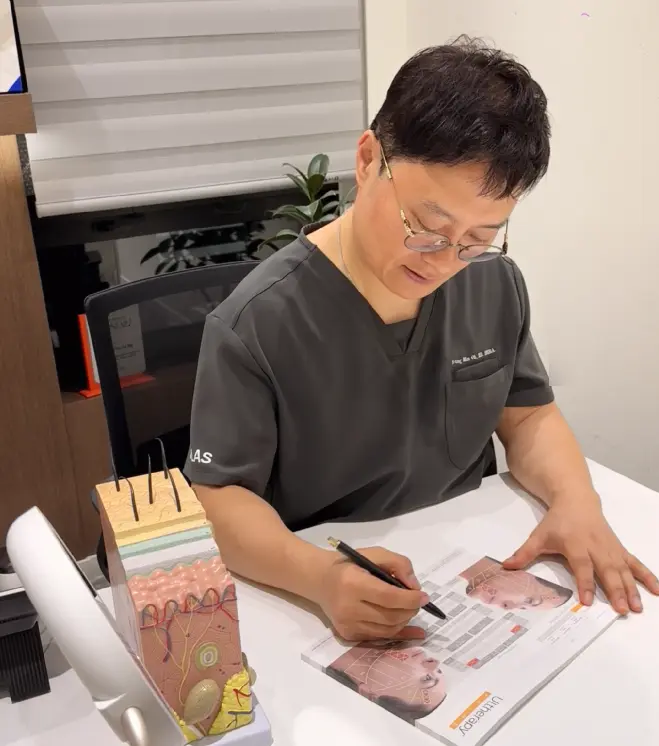
In nasolabial fold consultations, the first question is usually "Would Ultherapy be better, or Thermage?" But what we actually check first in the clinic is not the device name — it is whether the reason the nasolabial folds stand out lies more on the side of cheek sagging or on the side of reduced skin elasticity. Even with the same nasolabial folds, a different cause means a different direction to consider. In this article we lay out which concerns Ultherapy, Thermage, Oligio, and Titan each suit, and what to look at before settling on a combination.
Nasolabial folds may not be a matter of the lines around the mouth alone
If you see nasolabial folds only as a single line formed at the mouth, the approach easily goes off track. In some cases the cheek area droops downward so the line by the mouth folds and looks deeper, and in other cases the wrinkles look relatively more prominent as skin elasticity declines. Quite a few people have both situations overlapping.
Even when people describe the same concern, for some cheek sagging is the main cause, while for others the influence of reduced elasticity or fine lines is greater. The amount of facial fat and the thickness of the skin are also factors that bear on how prominent the nasolabial folds appear.
Rather than deciding on a device name first and fitting the cause to it, the order of checking the cause first and then finding an approach that matches it helps reduce individual variation in results.
That is why the process of pinpointing the cause comes before choosing a lifting combination. A more detailed piece on this way of distinguishing cause can be found in the criteria for dividing whether to look at sagging or elasticity first.
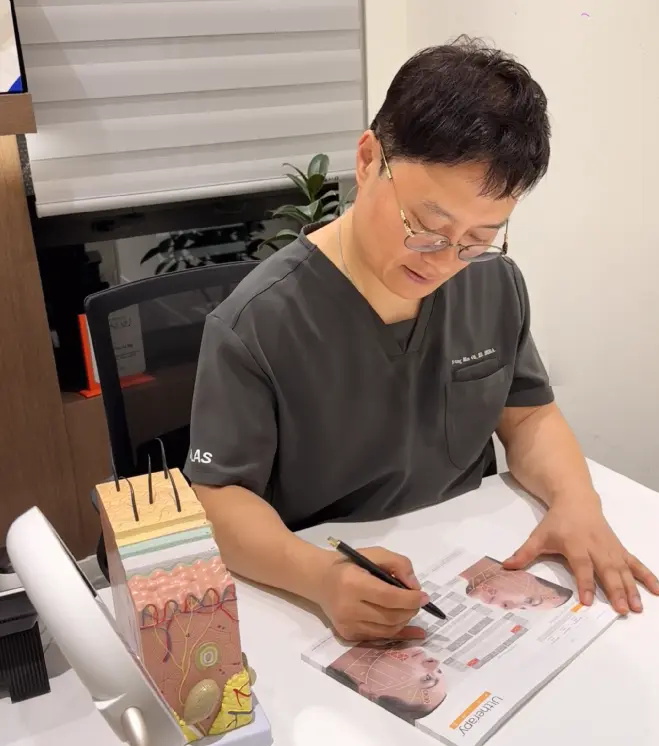
When the cheek sags and the nasolabial fold creases, why look at Ultherapy and Thermage together?
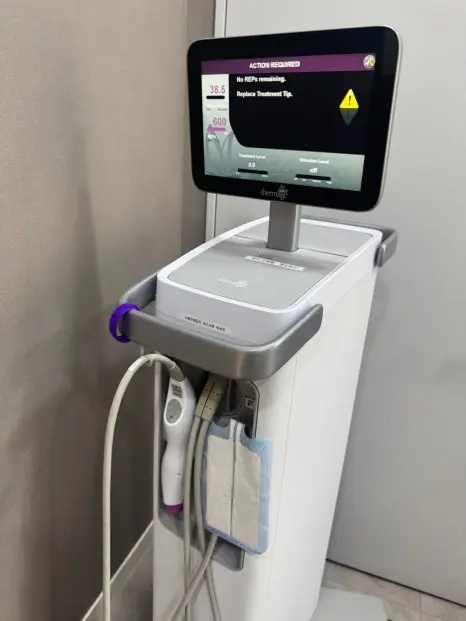
If cheek sagging is prominent and makes the nasolabial folds stand out, you can consider a combination of Ultherapy and Thermage. Ultherapy is a lifting procedure to look at when facial contour and sagging are the concern, and Thermage is a procedure to consider alongside it when management of reduced skin elasticity, fine lines, and skin texture is needed.
In other words, if the cheek is coming down so the nasolabial folds look deeper while at the same time the skin's own elasticity has declined, you can discuss an approach that addresses the direction of sagging across the whole face together with skin elasticity management.
That said, doing the two procedures together does not suit everyone equally. If the skin is thin or there is cheek hollowing, strong lifting can be a burden, and if there is a lot of fat, elasticity management alone may fall short of expectations. Before the procedure, we check the following factors together.
- Skin thickness and whether there is cheek hollowing
- Degree of cheek sagging
- Degree of reduced elasticity
- Amount of facial fat
- Prior procedure history
The reason we do not judge Thermage by shot count as a number alone is covered in a little more detail in the reason we do not judge Thermage shot count by numbers alone.
Get a consultation by chat now
When elasticity and the facial line blur together, when do we consider Oligio and Titan?
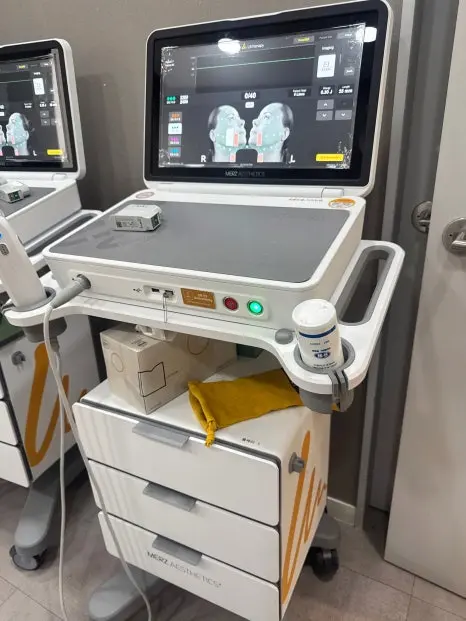
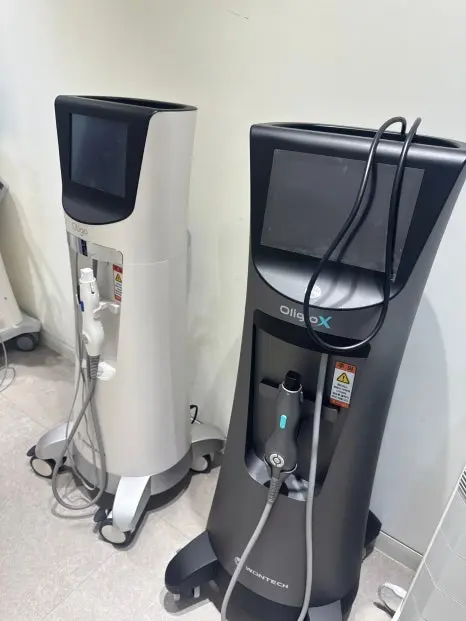
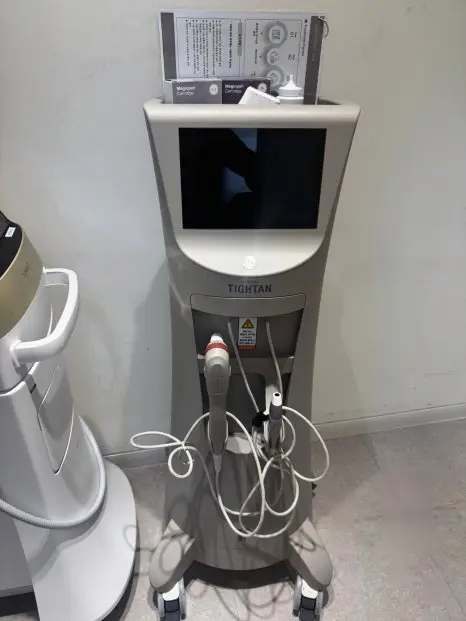
If you want to manage skin elasticity and the facial line together, a combination of Oligio and Titan is also an option. Oligio is a radiofrequency (RF) lifting procedure to look at when reduced skin elasticity, fine lines, and changes in skin texture are the concern, and Titan is a lifting procedure to consider when facial contour and reduced elasticity are both concerns.
In particular, this combination can be considered when the skin around the nasolabial folds looks less elastic than before, when fine lines by the mouth and changes in skin texture are felt together, or when the cheek loses elasticity so the jawline and facial contour look blurred.
Here is an at-a-glance summary of which concerns the four devices mainly relate to.
| Device | Concerns mainly addressed |
|---|---|
| Ultherapy | Facial contour, cheek sagging |
| Thermage | Reduced skin elasticity, fine lines, skin texture |
| Oligio | Reduced skin elasticity, fine lines, skin texture |
| Titan | Facial contour, reduced elasticity |
As the table shows, each device has a slightly different focus. So just because nasolabial folds are the concern, unconditionally combining several devices is not the right answer. The needed direction diverges depending on whether the cause is reduced elasticity, cheek sagging, the influence of fat volume, or an issue of skin thickness. What to check before OligioX and before Titan respectively is organized separately in things to check before OligioX at Nonhyeon Station and things to check before Titan Lifting at Sinnonhyeon.
The order we check first in the clinic before deciding on a combination
There is a good order to go through before deciding on nasolabial fold lifting.
- Identifying the cause the nasolabial folds look prominent — whether it is cheek sagging or reduced elasticity, or whether the two factors overlap
- Checking skin condition — examining skin thickness and elasticity in advance with tools such as an AI skin measurement device
- Checking facial structure and fat volume — cheek hollowing, fat volume, and the balance of the whole face
- Consultation with the medical staff — discussing the device, intensity, and combination direction that suit your individual condition
Rather than deciding on online information or recommendations from those around you alone, we recommend discussing thoroughly with the medical staff a direction that suits your own skin characteristics and facial condition. The way the approach diverges by wrinkle type is also covered in the reason procedures diverge by wrinkle type.
After the procedure, temporary redness, swelling, and pain may appear depending on the individual, and rarely burns or cheek hollowing and the like are also reported. It is advisable to decide carefully after being informed, before the procedure, of such possibilities, the recovery process, and even the individual limitations. If you have questions, feel free to ask comfortably through getting a consultation by chat.

Frequently asked questions
For nasolabial folds, which is better, Ultherapy or Thermage?
It is hard to say flatly which is better. The case where cheek sagging emphasizes the nasolabial folds and the case where reduced elasticity is the main cause can call for different approaches. It is better to check skin thickness, fat volume, and the degree of sagging together, and then find the direction that suits you through consultation with the medical staff.
Does receiving Oligio and Titan together help nasolabial fold improvement more?
The Oligio and Titan combination can be considered when reduced elasticity and changes in the facial line are both concerns. However, combining devices does not suit everyone equally, and the needed direction differs by cause. We recommend first checking through consultation whether it suits your individual condition.
What side effects can occur after nasolabial fold lifting?
Depending on the individual, temporary redness, swelling, and pain may appear. Rarely, burns or cheek hollowing and the like are reported, so it is important to be sufficiently informed by the medical staff of the possibilities and the recovery process before the procedure.
My skin is on the thin side — can I still receive nasolabial fold lifting?
If the skin is thin or there is cheek hollowing, strong lifting can be a burden. In such cases, it is advisable to first check skin thickness and facial structure, and then consult thoroughly with the medical staff about a direction and intensity that suit your individual condition.
What is worth checking in a nasolabial fold lifting consultation?
It helps to check together the degree of cheek sagging, skin thickness, fat volume, whether there is reduced elasticity, and prior procedure history. You need to first identify the cause the nasolabial folds look prominent in order to find the direction that suits you.
Recovery and downtime: it tends to settle within a few days
Ultherapy, Thermage, Oligio, and Titan are lifting procedures that use ultrasound or radiofrequency energy; because they involve no incision, the return to daily life tends to be relatively quick. Right after the procedure, redness, mild swelling, and a warm or tingling sensation may appear, but these tend to settle within a few days, and the recovery pattern varies with the device, intensity, area, and individual. Rarely, burns or cheek hollowing and the like are reported, so it is good to be guided on aftercare and precautions together during the consultation.
How the cost is made up
The cost of nasolabial fold lifting is less a single fixed figure than something divided across several factors. It varies by which of Ultherapy, Thermage, Oligio, or Titan is used, whether it is a single device or a combination, the number of shots or lines, the extent of the area (only around the nasolabial folds or the whole face), and whether aftercare is included. Even with the same device, the needed extent differs by cause and skin condition, so it is more accurate to be guided on a specific figure after skin measurement and consultation with the medical staff, tailored to your individual condition.
Visiting from abroad and consultation
On Clinic is located within walking distance of Sinnonhyeon and Gangnam Stations on the subway, convenient for visitors coming to Korea for aesthetic care. Consultation is available in your language, with interpretation support if needed, and if you organize your questions in advance through chat consultation, the visit tends to go more smoothly. Reservations and consultations can be arranged comfortably by chat.
Written by Dr. Oh Seung-min (Representative Director of On Clinic, graduate of Seoul National University College of Medicine, Chair of the Academic Committee of the Korean Society for Laser Dermatology and Hair). His detailed background can be found under Meet the Medical Team. First published 2026-06-11 / Last reviewed 2026-07-09
This article is intended to provide general information; suitable treatment and results may vary depending on individual conditions.


