
Zygoma Revision Surgery: Resolving Step Deformity and Asymmetry
Step deformities or asymmetry that occur after zygoma surgery can cause significant stress for patients. Revision surgery, in particular, is far more complex and challenging than the initial surgery, making precise diagnosis and delicate approaches by experienced medical staff essential. This case study details the process of revision surgery to resolve step deformities and asymmetry that occurred after a previous zygoma surgery.
Diagnosing Problems from Previous Surgery
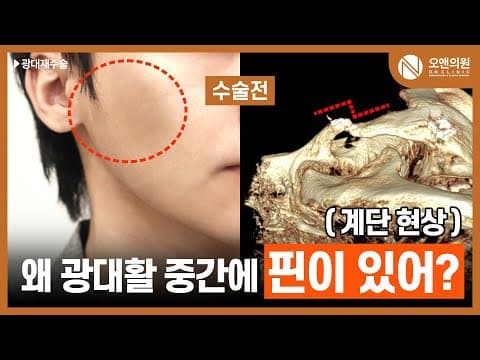
The patient had previously undergone zygoma reduction surgery but experienced asymmetry in both cheekbones and a 'step deformity,' where certain areas appeared sunken, after the procedure. Precise analysis through 3D CT scans revealed several issues.
- Fixation Pin Placement Issue: The fixation pins used in the previous surgery were located too far forward on the zygoma. Dr. Myungjun Oh explained, "These fixation pins were cut too far forward, and there's a significant difference between the two sides," pointing out that this led to an imbalance and exacerbated asymmetry of both cheekbones.
- Cause of Step Deformity: The phenomenon where the osteotomy site of the zygoma does not connect smoothly and appears to be bent like a step typically results from incomplete osteotomy or fixation failure. The CT images clearly showed the zygomatic arch bent like a step. Dr. Myungjun Oh added, "We call it a step deformity when it looks sunken and shadowed."
- Difficulty in Removing Fixation Pins: The pins fixed to the existing zygomatic arch were extremely difficult to remove. This posed a significant constraint in planning the revision surgery, necessitating a highly complex procedure where new fixation had to be added while retaining the existing pins. Dr. Myungjun Oh emphasized, "It was a high-difficulty surgery where the pins fixed to the zygomatic arch could not be removed, and revision surgery had to be performed while maintaining them."
Revision Surgery Plan and Procedure
Considering the patient's unique case, Dr. Myungjun Oh sought ways to improve the shape of the zygoma and securely fix it while retaining the existing fixation pins as much as possible.
1. Zygomatic Arch Correction and New Fixation Method
CT analysis revealed that the osteotomy was performed a staggering 11mm anterior to the intended cutting position. Dr. Oh's explanation, "And it was cut 11mm anterior to where it should have been cut," clearly illustrates the problem with the previous surgery. In such cases, simply removing the existing pins is not enough; it is crucial to stably reposition the bone using a new fixation method.
- Retaining Existing Pins and Adding New Fixation: If the existing fixation pins are securely in place, they are not necessarily removed. Instead, new fixation pins are added over them to correct the zygoma into a straight line. Dr. Myungjun Oh explained that the procedure would involve "checking both sides, and if the fixed area is firm, not removing them, but adding new connections here and here."
- Resolving Step Deformity: As Dr. Oh diagnosed, "The stepped zygomatic arch is this area in the picture, and it can be resolved by making the stepped zygomatic arch straight." The key is to transform the bent zygomatic arch into a smooth, straight line. This requires complex techniques that go beyond simply shaving the bone, involving precise refinement of the bone connection points and secure fixation in a new position.
2. Improving Midface Volume and Contours
By sufficiently moving the zygoma inward through revision surgery, the overall volume and contours of the midface can also be improved. Pre-surgery CT scans showed the zygoma protruding beyond the skull, while post-surgery images reveal it naturally receding inward, resulting in a smaller and more contoured face.
"Before surgery, the cheekbones protruded more than the skull, but after surgery, you can see them receding inward, right? And you can also see the midface becoming more contoured, right?" As Dr. Myungjun Oh explained, revision surgery aims for a three-dimensional change that considers the overall harmony of the face, going beyond merely reducing protruding cheekbones.
Chat with us now for a consultation
Surgical Results and Patient Satisfaction
Despite the challenging nature of revision surgery, successful results were achieved thanks to Dr. Myungjun Oh's extensive expertise and precise surgical planning. Post-surgery CT scans confirmed that the step deformity was perfectly corrected, and both zygomas were symmetrically and smoothly reduced. The patient also expressed high satisfaction with the improved facial contours.
While revision surgery involves more considerations and is more challenging than initial surgery, satisfactory results can be achieved through accurate diagnosis and customized planning with an experienced specialist and thorough consultation.
On Clinic Dr. Myungjun Oh | Last reviewed 2024-07-30