
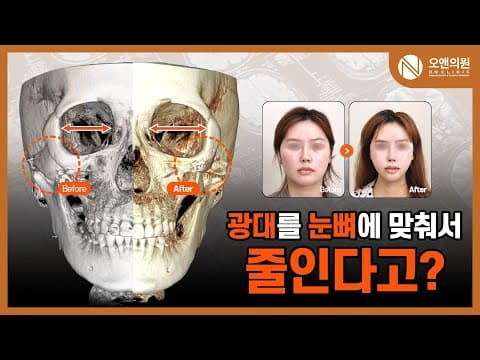
This video captures Dr. Myungjun Oh of On Clinic consulting with a patient about zygoma and midface reduction surgery and analyzing the surgical results. The patient inquired about ways to enhance her beauty and was curious about how much smaller her face could become through surgery.
Diagnosing Complex Midface and Zygoma Issues
In my initial consultation with the patient, I diagnosed that her midface needed to be reduced for her to achieve greater beauty. Specifically, I found severe facial asymmetry, with the right side of her face being significantly larger than the left. The patient expressed concerns about a bone gap and a sunken feeling in her right cheekbone area.
CT scan results revealed that the primary reason for the patient's face appearing large was not solely the size of the cheekbones themselves, but rather the difference in bone size in the midface and asymmetry of the skull. The left side of the skull was relatively slender, while the right side had a broader shape, contributing to overall facial asymmetry and enlargement. Furthermore, it was confirmed that the bone gap in the right cheekbone could be 100% improved, and the left bone gap could be improved by approximately 95%.
On Clinic's Approach to Zygoma and Midface Reduction Surgery
My surgical goal is not merely to reduce the cheekbones, but to move them inward, aligning them with the eye sockets, thereby reducing the entire midface and improving facial asymmetry. This method yields the following effects:
- Midface Reduction: Moving the cheekbones inward to align with the eye sockets reduces the width of the midface.
- Asymmetry Improvement: Adjusting the position and size of the left and right cheekbones resolves facial asymmetry.
- Effect of Larger-Looking Eyes: As the cheekbones move inward, the eyes appear proportionally larger, creating a more defined impression.
In the past, many patients who underwent zygoma reduction surgery often reported "no effect" or "developed asymmetry." This was because they received surgery to reduce only the cheekbones, even though the cause of their face appearing large was in the midface, not the cheekbones. At On Clinic, we identify these fundamental causes and establish optimized surgical plans for each individual patient.
"It's not that the cheekbones are large; it's the midface bones that are large. The cheekbones haven't shrunk; their size is the same. It's the midface that has been reduced."
Chat with us now for a consultation
Post-Surgical Result Confirmation
One week after surgery, despite residual swelling, the patient showed a noticeably improved facial contour. Through post-surgical CT images, I personally showed the patient that her cheekbones had been ideally reduced to align with her eye sockets, and that her midface size had been effectively reduced. The bone gaps were also confirmed to have completely disappeared or significantly improved.
These results are possible because the surgery was performed considering the asymmetry of the cheekbones and the overall facial proportions. When the cheekbones are reduced to align with the eyes, the eyes appear proportionally larger, creating a visual effect of bigger eyes. At On Clinic, we prioritize accurate diagnosis and meticulous surgical planning to ensure our patients achieve satisfactory results.
Dr. Myungjun Oh, On Clinic | Last reviewed 2026-05-23